Pages

Saturday, November 6, 2021

The Army And IAF Launch Major Exercise in Eastern Ladakh

            The Army And IAF Launch Major Exercise in Eastern Ladakh 


The Army and IAF on Monday started off a significant "airborne inclusion and battle" practice along the wilderness with China in eastern Ladakh, which will see paratroopers work on a catching area "behind foe lines" and afterward "interface up" with their propelling tanks while assault helicopters obliterate antagonistic automated powers. The three-day work out, with many pre-accustomed soldiers and weighty weapon frameworks at an elevation of more than 14,000-feet and short 20 degree Celsius temperatures, is intended to pass on one more "clear message" to China after the Agni-V rocket test last week to "cease from any misfortunes along the northern lines" .The battle moves come in the midst of the proceeding with halt in the 18-drawn out military showdown in eastern Ladakh, with China declining to try and finish the slowed down troop withdrawal at Patrolling Point-15 in the Hot Springs-Gogra-Kongka La region in the thirteenth round of corps administrator level discussions on October 10. 


With any de-acceleration in the significantly more unmanageable face-offs at Charding Ninglung Nallah (CNN) track intersection at Demchok furthermore, the deliberately found Depsang Plains likewise not too far off, India and China are set to keep their 50,000 soldiers each  alongside tanks, howitzers and surface-to-air rocket frameworks forward conveyed for the second successive winter in the cruel high-height region. "In case they (People's Liberation Army) are there to remain, we are there to remain as well," Army boss General M Naravane had as of late said. The PLA has additionally been utilizing its muscles, with moved forward watching along the 3,488-km LAC extending from eastern Ladakh to Arunachal Pradesh just as directing incorporated joint activities practices in the Tibetan Autonomous Region. 

The Indian exercise started on Monday with more than 200 Para-Special Forces officers from the Agra-based Shatrujeet Brigade, alongside expert vehicles, rocket separations and other weighty burdens, being embedded into the "drop zone" in eastern Ladakh by C-130J Super Hercules and AN-32 airplanes from five unique "mounting bases" in the country. 


"The point was to approve quick reaction capacities, between theater move, accuracy deadlock drops, fast gathering and catch of assigned destinations with speed and shock. The air-drop was especially difficult because of the freezing temperatures. 

More than two days, the paratroopers will "hold" the caught region in the reenacted work out, while adversary tanks are killed by assault helicopters like the recently accepted Apaches. "Agreeable" principle fight tanks and infantry battle vehicles, in turn, will push ahead to connect up with the paratroopers holding ground to finish the battle moves. 

The activity includes direct of oxygenated battle free-fall bounces and incorporated fight drills via airborne powers, motorized sections and assault helicopters with consistent joining,". 

India has forward conveyed a wide cluster of weapon frameworks — going from the Bofors, M-777 and K-9 Vajra cannons firearms to T-21, 90S and T-72 principle fight tanks, Smerch and Pinaka different dispatch rocket frameworks, and BrahMos supersonic voyage rockets along the LAC since the showdown ejected in April-May a year ago. 

Likewise, the IAF also has conveyed Sukhoi-30MKI, Mirage-2000, MiG-29 and Jaguar contenders too Apache assault and Chinook substantial lift helicopters in Ladakh and somewhere else along the LAC. 

However India falls behind China being developed of boundary foundation and last-mile troop availability, the development of extra streets, ammo asylums, extensions and passages in forward regions has additionally been a main concern region for the Border Streets Organization during the emergency.

Sunday, October 31, 2021

India deploys Pinaka, Smerch rocket systems on China border

Indian Army has deployed Pinaka and Smerch Multiple Rocket Launcher Systems (MRLS) at forward position near the China border to counter any threat arising across on the Line of Actual Control (LAC).
Pinaka weapon system is an autonomous rocket artillery system that can engage area targets up to 38km at mean sea level. At these altitudes, the ranges are enhanced significantly which further augments the deep strike capability of the weapon system.


A battery of six launchers of Pinaka can fire a salvo of 72 rockets in 44 seconds, thereby neutralising an area of 1000m by 800m. Talking about the weapon systems, deployed battery commander at the locationinformed that the Pinaka weapon system is indigenous multi rocket launcher system designed by Defence Research and Development Organisation (DRDO) and it is a state of art, completely autonomous weapon system, which can engage targets up to 38 kilometres at mean sea level and at higher altitudes, the ranges get significantly enhanced, which subsequently enhance our deep strike capability."

The advantage of Pinaka and Smerch to India's firepower, The quick reaction time and the high accuracy of these weapon systems ensure delivery of a very high volume of firepower on critical and time-sensitive enemy targets in a very short time.

The Smerch system is the longest range conventional rocket system in Indian army inventory having a maximum range of 90 Km. A battery of four launchers can fire a salvo of 48 rockets in 40 seconds neutralising an area of 1200m by 1200m.

The features of the Smerch weapon system, is that the launcher is a very potent weapon in the arsenal of Indian artillery. The weapon can fire up to a range of 90 kilometres. Being based on a 10 by 10 tatra, it's extremely mobile, and there is no issue with mobility in any sort of terrain. There are 12 tubes in the cluster, and it fires 12 rockets in a span of 40 seconds.


India successfully test-fires N-capable Agni-V Ballistic Missile with 5,000 km range


Intercontinental ballistic missile Agni-V is capable of striking targets at ranges up to 5,000 km with high accuracy. Test comes amid India's ongoing LAC stand-off with China.


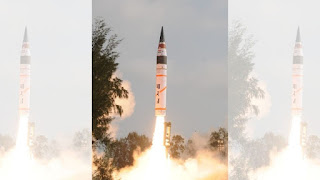
India on Wednesday 27 October, successfully test-fired the recently inducted Agni-V, the nuclear-capable intercontinental ballistic missile (ICBM), amid rising tensions with China along the Line of Actual Control (LAC).

The successful launch of the surface-to-surface ballistic missile, which has a range of over 5,000 km, was done at approximately 7:50 pm from the APJ Abdul Kalam Island in Odisha.

This is the first user launch of the missile, which was last tested in 2018, before it got inducted into the Strategic Forces Command that looks after India’s nuclear arsenal.

In a statement, the Defence Ministry said the successful test of Agni-V “is in line with India’s stated policy to have credible minimum deterrence that underpins the commitment to ‘No First Use’”.

The missile, which uses a three-stage solid-fuelled engine, is capable of striking targets at ranges up to 5,000 kilometres with a very high degree of accuracy, the ministry said. However, defence sources said the range is much more than the officially stated figure of 5,000 km.

India joins club of countries with ICBMs

Agni-V has the capability to reach almost every part of China, sources had said in 2018, when the missile was tested last by its developer, the Defence Research and Development Organisation (DRDO).

Interestingly, the DRDO is also working on a longer-range version of the Agni series of missiles.

The launch Wednesday comes just months after India also test-fired the Agni Prime, the next generation nuclear-capable ballistic missile in the nuclear arsenal.

While the Agni Prime and the rest of the Agni series is focussed primarily on Pakistan, the Agni-V is a much larger strategic weapon, capable of striking at much longer ranges.


Monday, October 18, 2021

Leads Leap


Rahul Gandhi Continues Using Language widely perceived as Undignified

Rahul Gandhi Continues Using Language widely perceived as Undignified Rahul Gandhi Continues Using Language widely perceived as Undignified...